
DSM
App control through the DSM interface, with the longest wireless range. Room-by-room schedules, open-window detection, an Away setting and a history of temperatures and energy use. Supports ErP-compliant operation.
The specifications behind the radTherm radiators we fit: dimensions, electrical details, how the heat-retaining core works, the thermostat options and the data sheets. Everything here comes from the manufacturer’s own catalogue and manuals.
At a glance
These apply across the Standard, Tall and Low radiators. For every individual size and output, see styles and sizes.
| Specification | radTherm Standard, Tall and Low |
|---|---|
| Depth | 70mm on every model |
| Heights | 340mm (Low), 630mm (Standard), 1240mm (Tall) |
| Outputs | 0.5kW to 2.8kW, fifteen sizes |
| Room size | Each radiator suits a room of 5 to 25m² |
| Supply | 230V, single phase |
| Connection | 1.5m cable with a 13A UK plug, or hard-wired to an existing circuit |
| Protection rating | IP20 as standard, IPX4 (splash-proof) available |
| Protection class | Class I |
| Mounting | Wall-mounted; Standard and Low can also stand on feet or castors |
| Finish | Powder-coated steel, white as standard, in 900+ colours to order |
| Made in | Germany, to order |
Inside the radiator
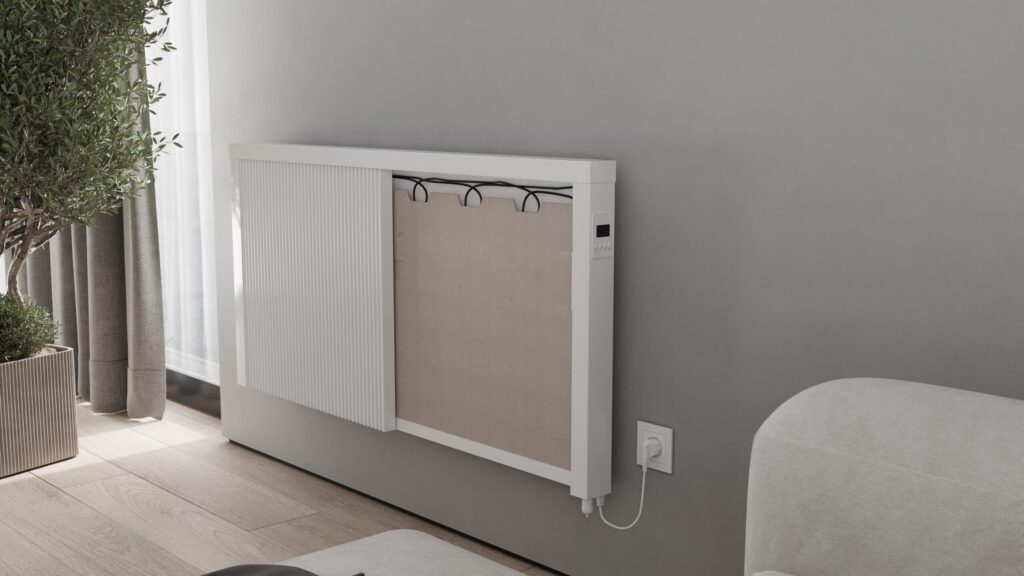
Each radiator has a patented heat-retention core with the heating elements cast directly into it, so almost all of the energy goes into stored heat. Once the room reaches the temperature you’ve set, the core keeps releasing warmth for up to 45 minutes without drawing any power.
Spot-welded fins on the front and back give the radiator six times the surface area of a flat panel. That spreads the heat as a mix of radiant warmth and gentle convection, so the room feels as warm at your feet as it does at head height.
Once a room is up to temperature, a radiator draws power for around 12 to 15 minutes an hour to keep it there (radTherm’s figure), depending on the building and the thermostat settings.
Case study
A 12-month case study looking at the total electrical usage (power, heat and light) in a 1960s two-bedroom detached bungalow in Holsworthy, North Devon, with cavity wall insulation, loft insulation and double glazing. There is no gas, solid fuel or other heating in the property.
| Over the 12 months | Cost |
|---|---|
| Heating | £501.15 |
| Everything else (lights, appliances, hot water) | £242.25 |
| Total electricity for the home | £743.40 |
Controls
Every size can be ordered with any of these. We’ll recommend one at the survey, based on how many rooms you’re heating and how you like to control them.
App control through the DSM interface, with the longest wireless range. Room-by-room schedules, open-window detection, an Away setting and a history of temperatures and energy use. Supports ErP-compliant operation.
Connects directly to your Wi-Fi router, no interface needed. Set in 0.5°C steps from 0 to 30°C, with adaptive start, open-window detection, a 24-hour boost and a key lock.
Two buttons on the radiator, each press moving the temperature by 1°C. Connect it to Wi-Fi later and it works with the same app as the others.
A built-in 868MHz radio receiver for an external wireless thermostat, with a range of around 30 metres indoors depending on the building.
The radTherm app works with Alexa and Google Assistant, so you can change a room’s temperature by voice.
Smart control and the appSafety and standards
Protection is built into each radiator at several points, and the steel body is powder-coated inside and out against corrosion.
DSD thermostats can limit output to 70% for a lower surface temperature, or 50% in Babycare mode. Low-temperature models are also available.
Seasonal space heating efficiency (ηS,el) of 96.0%, with weekly time control, open-window detection and adaptive start, as the Ecodesign rules for electric heaters require.
Documents
Features and specifications for the Wi-Fi thermostat. PDF.
Download the data sheetHow to set programmes, boost and the open-window function. PDF.
Download the instructionsEvery radiator, towel rail and water heater we fit, with photos and specifications.
The full brochureWhy Economy 7 storage heaters struggle, and what’s different now.
Modern vs oldDownload the brochure and we’ll email it straight over.